This event has been changed.Judith Reidy invites you to the Reception for Gallery Night and Day Plein Air Painting CompetitionChanged: Hope you came and watched the Artists in the Plein Air Event in the Third Ward this past week. NOW you are invited to ..... at the I hope you can come. I will be there till a little after 7 pm then I plan on dinner with you my friends. Will be looking for you! Judith
Going? | ||||||||
Invitation from Google Calendar You are receiving this courtesy email at the account judith_reidy.classes@blogger.com because you are an attendee of this event. To stop receiving future updates for this event, decline this event. Alternatively you can sign up for a Google account at https://www.google.com/calendar/ and control your notification settings for your entire calendar. Forwarding this invitation could allow any recipient to modify your RSVP response. Learn More. |
Sunday, July 16, 2017
Updated Invitation: Judith Reidy invites you to the Reception for Gallery Nig... @ Fri Jul 21, 2017 5pm - 8pm (CDT) (judith_reidy.classes@blogger.com)

Friday, July 14, 2017
Lesson #2 Part 2 What does I mean to be an artist? Edward Hopper
In the previous article we thought about what it may mean to be an artist and finding your artist voice. I discussed my thoughts about finding my" voice" as well as shared the opinions of others. One particular article by Jerry Saltz I suggested that you read in order for you to get a handle on how one artist managed his career as an artist.
Today I want to look at the work of a particular artist named Edward Hopper. Edward Hopper is known as a Social Realist by some but a title he himself dismissed.
Edward Hopper quotes:
regarding Great Art and personal vision....
"Great art is the outward expression of an inner life in the artist, and this inner life will result in his personal vision of the world… …The inner life of a human being is a vast and varied realm."
More of me comes out when I improvise.
No amount of skillful invention can replace the essential element of imagination."
In: 'Statements by Four artists', Edward Hopper, in 'Reality' 1., Spring 1953, p. 8
"My aim in painting has always been the most exact transcription possible of my most intimate impression of nature."
"Originality is neither a matter of inventiveness nor method, it is the essence of personality."
Selden Rodman, 'Conversations with Artists' Capricorn Books, New York, 1961
Though I studied with w:Robert Henri, I was never a member of the Ash-Can School. You see, it had a sociological trend which didn’t interest me. [Hopper then proceeded to inform Kuh that his work contained no social content whatsoever]
In: 'Edward Hopper' (1962), Katherine Kuh, in 'The Artist’s Voice: Interviews with Artists' New York: Harper and Row, 1962:140
regarding Painting....
"If you could say it in words there would be no reason to paint.
More of me comes out when I improvise.
No amount of skillful invention can replace the essential element of imagination."
- I do not know why I chose one subject rather than another unless I believe them to be the best synthesis of my inner experience.
- Floyd Goodrich 'Edward Hopper' H. Abrams, New York 1971
- It is hard for me to know what to paint. It comes slowly.
- quoted by Gail Levin 'Edward Hopper - an intimate biography' (1995)
- It takes a long time for an idea to strike.
- quoted by Sheena Wagstaff 'Edward Hopper' Tate Publishing (2004)
- The whole answer is there on the canvas.
- Answer to journalists -quoted by Sherry Maker 'Edward Hopper '(1990)
- The man's the work. Something does not come out of nothing.
- Answer to journalists -quoted by Avis Berman -Article ' Hopper, the Supreme American Realist of the 20th Century' Smithsonian Magazine June 2007
- Maybe I am not very human - what I wanted to do was to paint sunlight on the side of a house.
- Comment on his 'Early Sunday Morning' (1930)
- The only quality that endures in art is a personal vision of the world. Methods are transient: personality is enduring.
- In: 'statement by the Chairman of the Jury', Corcoran Gallery of Art, Washington D.C. 1951, p. 7
- I wish I could paint more.. I do dozens of sketches for oils.. if I do one that interests me I go on to make a painting but that happens only two or three times a year.
In 1930, his painting House by the Railroad (1925; Museum of Modern Art, New York)
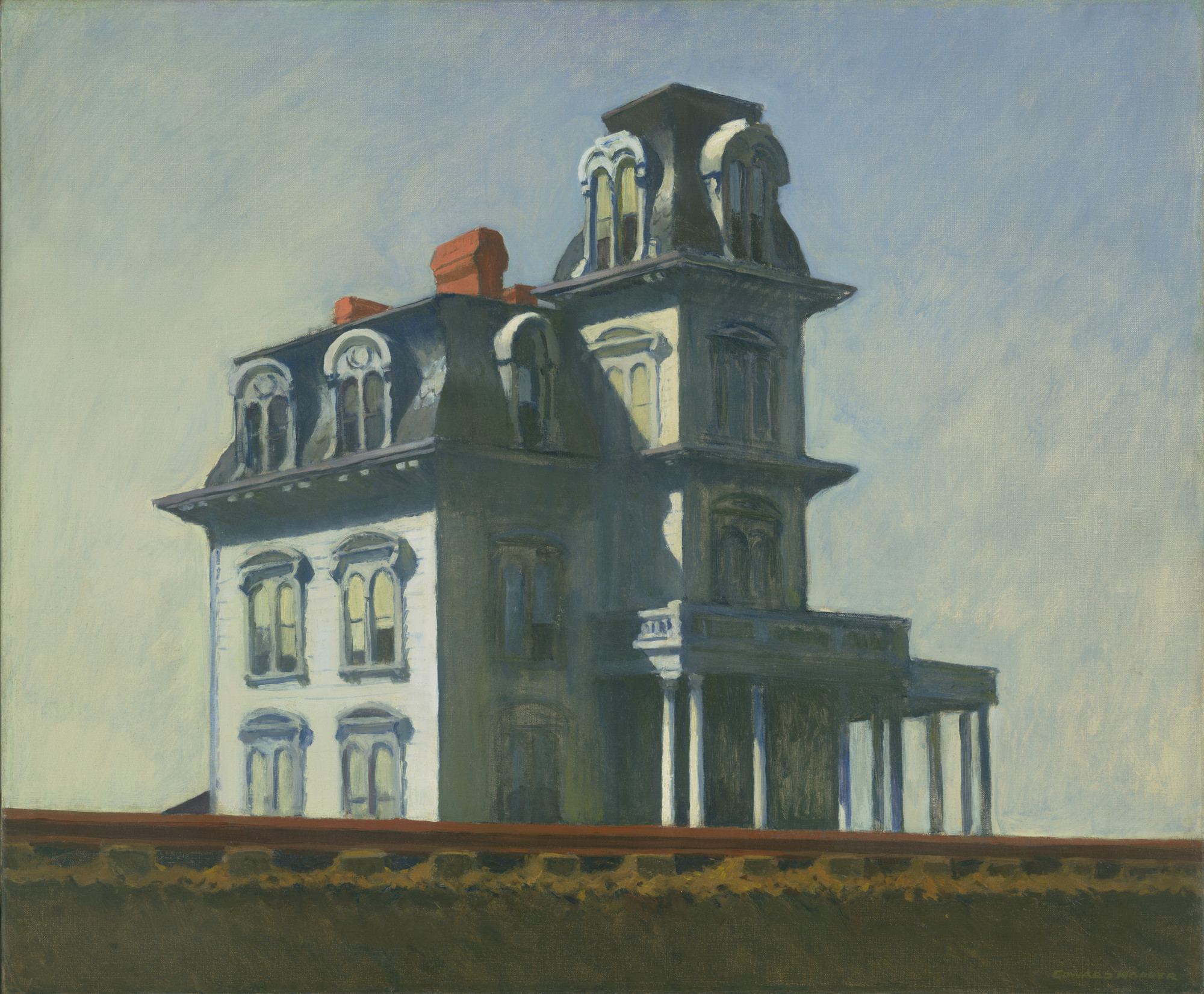
was the first work to be acquired for the collections of the newly founded Museum of Modern Art. This image embodied the characteristics of Hopper’s style: clearly outlined forms in strongly defined lighting, a cropped composition with an almost “cinematic” viewpoint, and a mood of eerie stillness.
He was by then celebrated for his highly identifiable mature style, in which urban settings, New England landscapes, and interiors are all pervaded by a sense of silence and estrangement (
25.31.2). His chosen locations are often vacant of human activity, and they frequently imply the transitory nature of contemporary life. At deserted gas stations, railroad tracks, and bridges, the idea of travel is fraught with loneliness and mystery (
37.44). Other scenes are inhabited only by a single pensive figure or by a pair of figures who seem not to communicate with one another. These people are rarely represented in their own homes; instead, they pass time in the temporary shelter of movie theaters, hotel rooms, or restaurants (
31.62). In Hopper’s most iconic painting, Nighthawks (1942; Art Institute of Chicago),

25.31.2). His chosen locations are often vacant of human activity, and they frequently imply the transitory nature of contemporary life. At deserted gas stations, railroad tracks, and bridges, the idea of travel is fraught with loneliness and mystery (
37.44). Other scenes are inhabited only by a single pensive figure or by a pair of figures who seem not to communicate with one another. These people are rarely represented in their own homes; instead, they pass time in the temporary shelter of movie theaters, hotel rooms, or restaurants (
31.62). In Hopper’s most iconic painting, Nighthawks (1942; Art Institute of Chicago),
four customers and a waiter inhabit the brightly lit interior of a city diner at night. They appear lost in their own weariness and private concerns, their disconnection perhaps echoing the wartime anxiety felt by the nation as a whole.
45.157.2). Wherever he traveled, however, Hopper sought and explored his chosen themes: the tensions between individuals (particularly men and women), the conflict between tradition and progress in both rural and urban settings, and the moods evoked by various times of day.
Wednesday, July 12, 2017
Invitation: Drawing and Painting class in all media @ Weekly from 12:30pm to 2:30pm on Wednesday (CDT) (judith_reidy.classes@blogger.com)
|


Drawing and Painting class in all mediaWe will be reviewing the Elements of Design today? Bring your notebook
Going? | ||||||||||||||||||||||||||||||
Invitation from Google Calendar You are receiving this courtesy email at the account judith_reidy.classes@blogger.com because you are an attendee of this event. To stop receiving future updates for this event, decline this event. Alternatively you can sign up for a Google account at https://www.google.com/calendar/ and control your notification settings for your entire calendar. Forwarding this invitation could allow any recipient to modify your RSVP response. Learn More. |
Tuesday, July 11, 2017
Lesson 2 Part 1 Finding Your Voice as an Artist or WHAT DOES IT MEAN TO BE AN ARTIST?
Before I continue in our next study of composition, I want to discuss finding YOUR VOICE as an artist.
Besides some of my children, my students are some of the most engaging people in my life. I am continually challenged by them and opened to new ways of thinking by them either technically in terms of painting or drawing or creative ideas but more significantly in terms of the question...
WHAT DOES IT MEAN TO BE AN ARTIST? OR
WHEN WILL I KNOW WHEN I AM AN ARTIST?
I am sure there are many people who have a clear idea how to answer that question. But I am not sure the answer is that clear especially for so many of us.
To me it is an identity question. A child may come up the question. WHEN WILL I BE A GROWNUP? To me that is like asking when will I qualified as a bona fide adult with all the privileges of adulthood (responsibilities not under consideration in this questions at this time.) That is a cultural and social question looking to a specific cultural and socially acceptable goal. Meeting the standards of a socially acceptable cultural concept of being a grown up can often feel less than fulfilling. One could be classified an adult, with adult privileges and responsibilities and still feel something is MISSING.
For some students that idea of becoming an ARTIST appears on first blush to be answer to that missing part in their life. For other students making paintings is something they do....nothing more. I am speaking to those students who look to MAKING ART AS AN ARTIST as a way to FILLING THE MISSING PART.
The question goes to the core of your humanity. Why are you here? Many of our social, political and religious institutions have answers for you providing you with causes and purposes to drive your life. But can you unabashedly embrace any of them wholeheartedly? If you can you may have a place to find a VOICE. BUT IS IT YOUR VOICE? Perhaps!
But for me it has not been that easy. Perhaps I am disillusioned. Perhaps I am stubbornly independent. Perhaps I don't like the feeling that I am putting on someone's worn and used garment. Perhaps I am conflicted because the people I love or feel I must answer to have no use for MY VOICE. Finding ones personal VOICE is a self journey into ones motivations. It is not a journey for the faint hearted.
For me social causes do not ring true. I have a metaphysical side that is empowered by the BIG questions and dwells in the wonder and beauty I have an eye to see in spite of life's sojourns into disillusionment. I am blessed in that I have not lost heart or sight of the light at the end of the tunnel, like so many tired souls in retirement years.
My journey is not identical to your journey nor can it be. Every artist you will look at will be different. Each must find their own way.
One such artist I want to look at was brought to my attention by a student recently. This artist has work that has compositional elements that I think would be interesting to discuss but also has a VOICE that speaks to the cyclical story about the rural American. The name of the artist is Edward Hopper.
In the next post we will look at Edward Hopper "Cobb's Barns, South Truro"
From the INTERNET...
What does it mean to be an artist?
Being an artist means putting your best feet forward everyday and to create things that makes a difference; whether that difference is for you, or for others. ... That's what being an artist means to me. Being unsure if what you do will resonate with others, but you need to say something all the same.Sep 24, 2013
An artist is a person engaged in an activity related to creating art, practicing the arts, or demonstrating an art. The common usage in both everyday speech and academic discourse is a practitioner in the visual arts only.
Artist - Wikipedia
https://en.wikipedia.org/wiki/Artist
Artist | Define Artist at Dictionary.com
www.dictionary.com/browse/artist
a person who practices one of the fine arts, especially a painter or sculptor. 3. a person whose trade or profession requires a knowledge of design, drawing, painting, etc.: a commercial artist. 4.
Besides some of my children, my students are some of the most engaging people in my life. I am continually challenged by them and opened to new ways of thinking by them either technically in terms of painting or drawing or creative ideas but more significantly in terms of the question...
WHAT DOES IT MEAN TO BE AN ARTIST? OR
WHEN WILL I KNOW WHEN I AM AN ARTIST?
I am sure there are many people who have a clear idea how to answer that question. But I am not sure the answer is that clear especially for so many of us.
To me it is an identity question. A child may come up the question. WHEN WILL I BE A GROWNUP? To me that is like asking when will I qualified as a bona fide adult with all the privileges of adulthood (responsibilities not under consideration in this questions at this time.) That is a cultural and social question looking to a specific cultural and socially acceptable goal. Meeting the standards of a socially acceptable cultural concept of being a grown up can often feel less than fulfilling. One could be classified an adult, with adult privileges and responsibilities and still feel something is MISSING.
For some students that idea of becoming an ARTIST appears on first blush to be answer to that missing part in their life. For other students making paintings is something they do....nothing more. I am speaking to those students who look to MAKING ART AS AN ARTIST as a way to FILLING THE MISSING PART.
The question goes to the core of your humanity. Why are you here? Many of our social, political and religious institutions have answers for you providing you with causes and purposes to drive your life. But can you unabashedly embrace any of them wholeheartedly? If you can you may have a place to find a VOICE. BUT IS IT YOUR VOICE? Perhaps!
But for me it has not been that easy. Perhaps I am disillusioned. Perhaps I am stubbornly independent. Perhaps I don't like the feeling that I am putting on someone's worn and used garment. Perhaps I am conflicted because the people I love or feel I must answer to have no use for MY VOICE. Finding ones personal VOICE is a self journey into ones motivations. It is not a journey for the faint hearted.
For me social causes do not ring true. I have a metaphysical side that is empowered by the BIG questions and dwells in the wonder and beauty I have an eye to see in spite of life's sojourns into disillusionment. I am blessed in that I have not lost heart or sight of the light at the end of the tunnel, like so many tired souls in retirement years.
My journey is not identical to your journey nor can it be. Every artist you will look at will be different. Each must find their own way.
One such artist I want to look at was brought to my attention by a student recently. This artist has work that has compositional elements that I think would be interesting to discuss but also has a VOICE that speaks to the cyclical story about the rural American. The name of the artist is Edward Hopper.
In the next post we will look at Edward Hopper "Cobb's Barns, South Truro"
From the INTERNET...
What does it mean to be an artist?
Being an artist means putting your best feet forward everyday and to create things that makes a difference; whether that difference is for you, or for others. ... That's what being an artist means to me. Being unsure if what you do will resonate with others, but you need to say something all the same.Sep 24, 2013
An artist is a person engaged in an activity related to creating art, practicing the arts, or demonstrating an art. The common usage in both everyday speech and academic discourse is a practitioner in the visual arts only.
Artist - Wikipedia
https://en.wikipedia.org/wiki/Artist
Artist | Define Artist at Dictionary.com
www.dictionary.com/browse/artist
a person who practices one of the fine arts, especially a painter or sculptor. 3. a person whose trade or profession requires a knowledge of design, drawing, painting, etc.: a commercial artist. 4.
I highly recommend that you take a good long look at this artists journey not as a model but as a story of his artistic journey. And don't forget to read the comments, which are equally insightful.
Check out
http://www.vulture.com/2017/04/jerry-saltz-my-life-as-a-failed-artist.html
The Art Story: Modern Artists Full List
www.theartstory.org/section_artists.htm
Below are biographies and analysis of the work of all the artists who were central to modern art.Saturday, July 8, 2017
Tonalism Lesson #1, Part 5 - Tonalist painting and how to think like a Tonalist painter.
Now to try on a new way of thinking and painting for you...... Try this experiment....
Now that I have showed you the process for thinking about composition, finding some structural elements, making a thumbnail, and starting a painting with a limited palette.
I would like you to try out the process with with the images below. If you demonstrate that you followed the process you can earn a sizable number of points to gain more chances to win.
Try some of these images...... which may utilize slightly different palettes. I suggest starting with strong contrast paintings first. As the subtle transitions in the close value paintings are more challenging.
30 pts when you hand in a tonalist painting.
Now that I have showed you the process for thinking about composition, finding some structural elements, making a thumbnail, and starting a painting with a limited palette.
I would like you to try out the process with with the images below. If you demonstrate that you followed the process you can earn a sizable number of points to gain more chances to win.
Try some of these images...... which may utilize slightly different palettes. I suggest starting with strong contrast paintings first. As the subtle transitions in the close value paintings are more challenging.
30 pts when you hand in a tonalist painting.
 |
| California Tonalism..... |
 | |
|
 |
Green Praire Rain Storm over Canola Field by I.M. Ruzz, Canadian Artist
black, white, yellow, sienna
|
 |
| Pink, Purple, Blue Sunset Oil Painting, Abstract Contemporary Tonalist Landscape by Jake Trujillo magenta, cad yellow, ultramarine blue black white |
 |
The Hourglass of Spring by Jan Benclowe acrylic
sienna, cad orange, white, black, ultramarine blue and alizarin
|
 |
Lovell Birge Harrison (American, 1854– 1929), Silence, ca. 1890
yellow ochre, thalo, black cad orange or sienna
|
 |
| Reflections In A Golden Pond by artist Maurice Sapiro take a look at more of Maurice Sapiro's work sienna, umber, cad yellow, white and black |
 |
by artist Leon Dabo
Thalo, cad orange, white with a touch of ochre, magenta or diaozine purple and maybe black
|
 |
| Approaching Storm by Dennis Sheehan burnt umber, yellow ochre, Paynes grey, veridian, white Look at the work of Sheehan |
 |
| Study after Paul Troulillebert - landscape by M Francis McCarthy burnt sienna, yellow ochre thalo blue, alizarin, white |
 |
| The Home of the Heron by George Inness burnt umber, yellow ochre, Paynes grey, white |
 |
Sunset by George Inness
yellow ochre, white, Quinacridone Red, ultramarine blue and Paynes Grey
|
 |
| by Jane Blebmcowe burnt sienna, ultramarine blue, yellow ochre, white, maybe Paynes grey |
 | |
| by Dennis Sheehan burnt umber, yellow ochre, Paynes grey, veridian, white |
 |
| by Maurice Sapiro burnt sienna, yellow ochre, Paynes grey, veridian, white |
 |
| tonalist landscape abstract from Matthew of Timber Trail Arts
burnt sienna, yellow ochre, Paynes grey, veridian, white
|
 |
Long Island Sunset by Charles Melville Dewy
burnt umber, yellow ochre, Paynes grey, veridian, white
|
 |
Oxbow of the Connecticut River by Wolf Kahn
burnt sienna, yellow ochre, ultramarine and white
 |
The Snow Field by Charles Warren Eaton
watercolor but could be done in other media
burnt seinna, prussian blue, yellow ochre, white
 |
| Gloaming Pines in Watercolor by Charles Warren Eaton burnt seinna, paynes grey, white |
other Tonalist work to look at is at this link. Enjoy!
Friday, July 7, 2017
TONALIST PAINTING Lesson #1, Part 4 - Tonalist painting and how think like a Tonalist painter.
Tonalist Lesson # 1 Part 4 How to approach making a Tonalist painting and how think like a Tonalist painter.
You have completed lesson 1 through 3, and have made your thumbnail sketch. We are going to talk about Tonalism and their color palette. Tonalist work in a limited palette. Often using analogous or neighboring colors and white. They work most often in earth tones, but not exclusively. The benefit of working in a limited palette for a beginning painter is the focus on value structure remains strong. Notan structure that is the light and dark pattern is very strong. Experienced artist have this simple structure in their head, but less experienced artists often do not. That is why I want my students to practice thinking in value structure by seeing and painting the Notan structure at the beginning of their painting.
 |
| by artist Teri Canelle Eramo |
4) Find a proportional canvas or panel ( this is important) then transparently paint in the dark pattern with a mid tone ( in this case of burnt umber checking it against the thumbnail and the source. That is the notan structure.
Let it dry
5) Paint in yellow ochre transparently in the light
6) Staying within the value range within the dark paint trees, ground, etc. Traditionally the early tonalists used a glazing technique applying layers of color with a medium ( oil painters used oil, while if you are going to try this in acrylic try using acrylic medium) You can used brushstrokes that go with the movement of the grass or shape of the tree forms.
7) Staying within the value range of the light begin painting sky and water.
Work with the four colors
Limit palette to...
- Paynes Grey( which is a blue black),
- raw umber( a greenish brown),
- yellow ochre
- and white. 4 colors only
8) At the very end we will add some green mixing it last from yellow ochre and paynes grey. And possibly adding a viridian or slight touch of thalo blue to the mixture. The Green must not be added until the end after the value structure is clarified. Do not do this until checking that you have recorded the values accurately.
The completed painting is worth 15 chances. (10)
The completed painting is worth 15 chances. (10)
MORE another day on ON DEVELOPING LAYERS WITH GLAZES
Next lesson
Subscribe to:
Posts (Atom)